How do you tell whether a septic system needs repair or replacement?
Repair is usually enough when the failure is a part: a broken baffle, a clogged effluent filter, a failed pump, a cracked line, or a clogged distribution box. Replace when the tank is cracked or collapsing, or when the drain field has stopped absorbing water. Most homes need a pumping every three to five years, and a system that needs pumping every few months is telling you something else is wrong.
Published cost guides for the Atlanta area put a replacement tank at about $1,200 to $3,000 and a new drain field at roughly $5,000 to $12,000. A pump or a section of line costs far less. That spread is why an evaluation before a decision is worth paying for: the wrong guess in either direction is expensive.
The state health department tracks these systems as ones that wear out over time, and the drain field is the part that usually goes first. A field that has failed cannot be fixed by pumping the tank, no matter how often you do it.
Want the price lines side by side? See the septic installation cost breakdown.
How do you know your septic system is failing?
Wet, spongy, or unusually green ground
Grass over the drain field that stays soggy, or grows much greener and faster than the rest of the yard, can mean liquid is rising to the surface because the soil below has stopped absorbing it. It is worst after rain, but a field that is wet in a dry week has a bigger problem.
Slow drains and gurgling in more than one fixture
One slow sink is a clog. Every drain slowing at once, toilets gurgling, and water backing up in the lowest shower or tub points to the main line, the tank, or the field.
Pumped, then full again within months
A healthy system gives you years between pumpings. If the tank refills fast, the liquid has nowhere to go, which is a field problem or a high water table problem, not a tank problem.
Odor, or a lid that is cracked or sunken
Sewage smell near the tank or field, or a lid that has cracked, shifted, or sunk, needs attention immediately. A broken lid is also a safety hazard for children, pets, and mowers.
What septic replacement includes
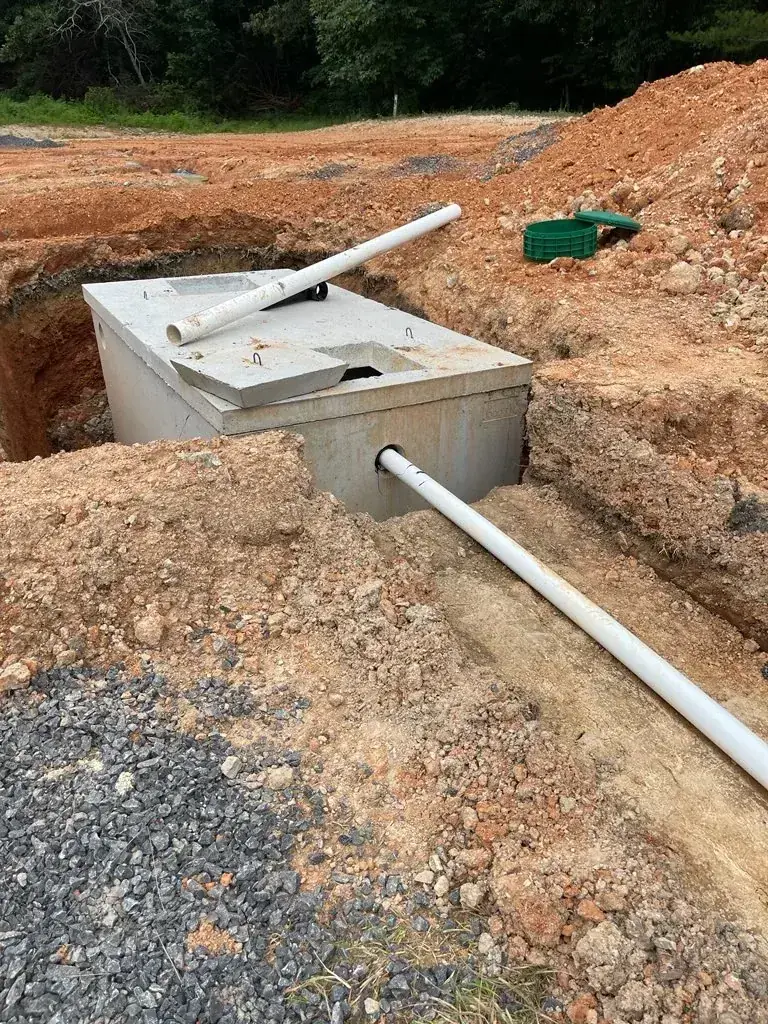
We remove the failed tank, set a new concrete tank sized for the permitted bedroom count, fit new risers and an effluent filter, reconnect the house line and the outlet, and call for the inspection before backfilling. Georgia sets a 1,000 gallon minimum, and approved concrete tanks are commonly made in 1,000 and 1,500 gallon sizes.
This makes sense when the tank itself is cracked, leaking, or collapsed and the field is still taking water.
When the soil can no longer absorb the liquid, the field is rebuilt, either in the same area if the soil has recovered and Environmental Health allows it, or on the reserve area or another approved location. The right size comes from a current soil report.
See drain field installation for how fields are laid out and what types exist.
Some jobs replace everything: tank, box, and field. Others modify a working system because the house is getting an extra bedroom. In both cases the permit follows the bedroom count, so bring the floor plan.
We plan the old system's removal or abandonment so open tanks are never left in a yard.
What changes for replacements in Dawson County
Repairs and replacements go to the same office as new systems: Dawson County Environmental Health, 189 Highway 53 West, Suite 102, (706) 265-2930, open Monday through Friday from 8 to 5 and closed noon to 1. Call for an appointment. Inspectors can require a new soil report for a repair, and they often do when the field is involved.
Three local conditions come up again and again.
- Older systems on newer lots. Homeownership in Dawson County runs near 78 percent, and many buyers take on a house whose septic record is thin. A permit search through Environmental Health is a good first step before any money is spent.
- Wells. Rural Dawson properties often have a well on the same lot. Placement of a new tank or field has to respect the distance to the well, so tell the inspector about every well on or near your lot.
- Proximity to water. The Etowah, Amicalola, and Chestatee rivers cross the county and Lake Lanier borders its southeast corner. Failing systems near water draw more attention. Georgia's environmental regulators have proposed nutrient limits for Lake Lanier, and Gwinnett County commissioned a study of how shoreline septic systems affect the lake.
The reserve area on your original plat, if you have one, is where a replacement field often goes. If a shed, pool, or driveway has been built over it, tell us early.
How a septic replacement works, step by step
Call and describe what you are seeing
Tell us the symptoms, when the tank was last pumped, and whether you have old permit paperwork. If wastewater is surfacing, say so first.
Pump and evaluate
We pump the tank and look at its condition and the way it refills. We also check the lines and the field. You get the findings in writing.
Permit with Environmental Health
A replacement or repair permit comes from Dawson County Environmental Health, and a soil report may be required. This is the compliance step. We do not start digging a new system without it.
Replace, inspect, and restore
The new system goes in, the inspection happens before backfill, and the yard is graded back. You get the paperwork and a marked reserve area.
Why homeowners call us before they commit
- Evaluation before replacement. We tell you what is actually broken before anyone suggests a new system.
- Free estimates, itemized. Tank, field, permit, and soil report are separate lines.
- Permits are not optional. The work follows Environmental Health rules, and we explain each step.
- Honest about timing. If the permit will take weeks, we tell you what to do in the meantime.