How much does a new septic system cost in Dawsonville?
Published cost guides for the Atlanta area put a septic tank at about $1,200 to $3,000 for a three or four bedroom home, a drain field at roughly $5,000 to $12,000, and soil testing at $700 to $2,000. National averages for a complete system and installation run from about $3,000 to over $10,000. Those are outside estimates, not our prices. See the full septic installation cost breakdown.
What moves a Dawson County quote up or down is mostly the lot. Bedroom count sets the tank size and the field size. Soil that drains slowly means a larger field. Shallow rock, steep slope, or a long run from the house to the field adds excavation and sometimes a pump. A lot that needs an engineered alternative system costs more than one that takes a conventional trench field.
We give a free, itemized scope of work estimate once we know the address, the bedroom count, and what the soil report says. If you do not have a soil report yet, we can still give you a range and tell you what would push it high or low.
How do you know you need a new septic system, not a sewer tie-in?
There is no sewer line at your road
Sewer in Dawson County is concentrated in and around the City of Dawsonville and parts of the GA 400 corridor. Past those areas, most lots have no line. Call Etowah Water & Sewer Authority at (706) 216-8474 or the City of Dawsonville at (706) 265-3256 and ask about your exact address before you assume either way.
Your builder or lender asks for a septic letter
Builders and lenders ask for it because the building permit paperwork does. If the letter is the missing piece, the soil report and Environmental Health approval are what produce it.
You own acreage with no existing system
Raw land, family tracts, and parcels split off a larger farm often have no permitted system on record. Ask Environmental Health whether anything is on file for the parcel before you pay for a design.
You are adding a second dwelling or a bedroom
A guest house or a major addition can need its own permit or a modification to the existing system. The answer depends on bedroom count and on what the current system was approved for, so check before you pour a foundation.
What our new construction septic work includes
Every job is different, but most land in one of three buckets.
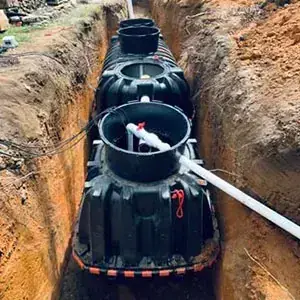
A concrete tank sized for the bedroom count, a distribution box, and a drain field laid out to match your soil report. Georgia sets a 1,000 gallon minimum tank, and approved concrete tanks are commonly made in 1,000 and 1,500 gallon sizes. We set the tank, build the field, connect the house line, and call for the inspection before anything is buried.
This is the right fit for lots with deep, well-drained soil and a gentle slope.
When the best soil sits uphill from the house or the lot drops away steeply, gravity will not carry the effluent where it needs to go. A pump or dose tank moves it to the field in measured amounts, which also spreads the load across the whole field instead of overloading the first few feet.
Foothill lots in northern Dawson County are where we most often see this.
The septic schedule has to fit around grading, the foundation, and the driveway. We talk to your builder or site contractor about where equipment can and cannot go, when trenches should be opened, and when the inspection has to happen so nothing gets covered too early.
If you are your own general contractor, we will walk you through the order of operations.
What changes for a new septic system in Dawson County
Dawson County is one of the fastest growing counties in the state. Census building permit counts for the county rose from 430 housing units in 2020 to 1,069 in 2025, and a chamber leader has noted that outside the GA 400 corridor and the city the county is still very rural. New homes on septic are the normal case here and permit demand is high, so start the septic steps early.
| Septic permit or letter | Dawson County Environmental Health, 189 Highway 53 West, Suite 102. Phone (706) 265-2930. Call for an appointment. |
|---|---|
| Recorded plat | From the Dawson County Clerk of Court. Required for building permits. |
| Land disturbance permit | A two step county permit, where it applies. |
| Driveway permit | If the driveway meets a county road. Ask for the encroachment contact at (706) 344-3500, ext. 42336. |
| Contractor license | Dawson County asks contractors to hold a county business license or signed affidavits. |
Inside the City of Dawsonville, the development permit goes through City Planning and Zoning at (706) 203-4923, and the checklist asks for a restroom facility permit from Environmental Health for the construction period. See the county listing of local agencies for the other offices involved.
Lot size matters. State guidance starts at roughly half an acre on public water and larger on a well, and a local board of health can require more. A lot that is large enough on paper can still fail if the usable soil sits where you wanted the house.
If the soil report comes back marginal, ask about alternative and mound systems before assuming the lot will not work.
How a new septic installation works, step by step
Call with the address and bedroom count
We ask about the lot, the house plan, and whether you will be on public water or a well. If the parcel might be near a sewer line, we point you to the right office to check before you spend on septic.
Soil evaluation
A certified soil classifier evaluates the lot and writes the soil report. We help you book it early, because the result can shift the house location and the bedroom count.
Design and Environmental Health permit
The system is designed from the soil report and submitted to Dawson County Environmental Health. This is the compliance step that every other permit depends on. Permits are generally valid for 12 months, so we time it to your build.
Install, inspect, and walk the site
We set the tank, build the field, and call for the inspection before covering anything. You get the permit paperwork and a marked reserve area on your plat.
Why homeowners and builders call us first
- We raise soil and permit problems before you commit. You hear about a failing soil test while it is still cheap to change the plan.
- Free estimates, itemized. The soil report, permit fees, tank, and field are separate lines, so you can compare quotes fairly.
- We plan around your builder. The septic schedule is built backward from your foundation and driveway dates.
- You deal with one person. Same contact from the first call through the final inspection.
Build your permit checklist if you want the steps in order before you call.