What does a perc test cost in Dawsonville, and what does it tell you?
A perc test, short for percolation test, measures how fast water moves through your soil, and it is one part of the soil evaluation Georgia requires before a septic permit. Published cost guides for the Atlanta area put soil testing for a septic system, perc test included, at about $700 to $2,000, and one national guide cites an average near $1,400. The report tells you whether the lot can take a septic system at all, how big the drain field has to be, and where it can go. It is the single most useful number-gathering step before you buy land or design a house.
| Soil type and drainage | How fast water moves through the soil, which sets the size of the drain field. |
|---|---|
| Depth to rock | Shallow rock limits trench depth and can rule out a conventional field. |
| Water table | A seasonal high water table can drown a field in wet months. |
| Slope | Steep ground can call for a pumped system or a different location. |
| Usable area | Where on the lot a field and a reserve area can actually go. |
The classifier's report goes to Dawson County Environmental Health, which uses it to decide whether the lot can be permitted and for how many bedrooms.
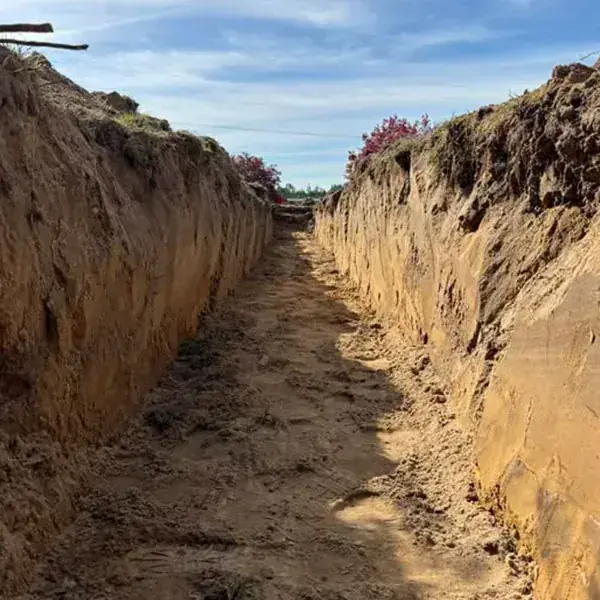
If the report shows shallow rock or a high water table, the next question is which alternative system fits.
How do you know you need a soil test?
You are buying land that is not on sewer
A soil evaluation during your inspection period turns a guess into a fact. It can protect you from paying for a lot that cannot be built on.
You are about to design or build a home
The soil report can move the house, change the bedroom count, and affect the driveway. It belongs before the plans are final.
Your existing system is failing
Repair and replacement permits sometimes require a new soil report, depending on what the inspector sees. Nearby Forsyth County's own application recommends a new report before any septic repair.
You are adding bedrooms or a second structure
More bedrooms mean more flow. The system may need to grow, and the health department will want the floor plan.
What our soil test and permit help includes
We explain what the classifier needs from you: access to the lot, marked corners, and the planned house location. We help you schedule it early so the result can inform the house plan, and we review the finished report with you in plain language.
We help you gather what the office asks for: the plat or survey, floor plan with bedroom count, well locations, and the soil report. A complete package gets reviewed faster than an incomplete one.
Once the permit is issued, we schedule the installation, call for the inspection before anything is covered, and coordinate with your builder so the sequence works.
Want the steps in order for your situation? Use the Dawson County septic permit planner.
How the permit works in Dawson County
Septic permits come from Dawson County Environmental Health, part of the Georgia Department of Public Health, at 189 Highway 53 West, Suite 102 in Dawsonville. The office is open Monday through Friday from 8 to 5, closed noon to 1, and asks you to call for an appointment at (706) 265-2930.
| Plat or survey | Lot lines, road, and any wells or structures. New building permits need a recorded plat from the Clerk of Court. |
|---|---|
| Floor plan | Bedroom count drives system size, so include every room that could become a bedroom. |
| Well locations | Report every well on or near the lot. |
| Soil report | From a certified soil classifier. The health department keeps the list. |
| Installer | Must be a Georgia DPH certified septic contractor, with a Dawson County business license or signed affidavits. |
Two things shape a Dawson County timeline. The county is growing quickly, with 1,069 housing units permitted in 2025 against 430 in 2020, so appointment slots can be tight. And permits are generally valid for 12 months from issue, so do not pull one too early. State guidance is at Georgia DPH Environmental Health.
If your lot touches the City of Dawsonville, city Planning and Zoning has its own checklist at (706) 203-4923. It also points to Environmental Health, so the septic permit is the common thread either way.
How the soil test and permit process works, step by step
Call Environmental Health
Ask what is on record for your address, what they need for your project, and how long appointments are running. Do this before you pay anyone.
Book the soil classifier
Pick a certified soil classifier from the list and schedule the evaluation. Mark lot corners and keep machines off the proposed field area.
Submit the application
Bring the soil report, plat, floor plan, and well locations. Environmental Health reviews the design and issues the permit. This is the compliance step, and everything else waits on it.
Install and inspect
A certified installer builds the system and calls for the inspection before it is covered. You keep the permit and as-built paperwork.
Why call us before you buy or build
- We start with the question that matters. Can this lot take septic, and for how many bedrooms?
- We know the order of the steps. Soil, then permit, then building permit, then install.
- We do not pad the process. If a step is not needed for your project, we will say so.
- Plain-language reports. We explain what the soil report means for your house plan.